![]() |
"It was the home Pierre Stone himself built. It had been in the family for generations.
Billy's parents had sold the place when it got beyond them.
Times change. You had to roll with it.
But it was impossible to roll without getting bruised."
Arthur and Jane are stewards of the Matteson/Metzger family farm on Crandall Hill in Potter County, Pennsylvania. We are proud to use organic methods with an eye to a more sustainable future.
![]() |
"It was the home Pierre Stone himself built. It had been in the family for generations.
Billy's parents had sold the place when it got beyond them.
Times change. You had to roll with it.
But it was impossible to roll without getting bruised."
Remember those days when you went to visit Smitty at his video store in the Damascus Plaza to select videos that might appeal to the whole family? Our kids were of the age that I could sometimes still select old favorites like Disney's Swiss Family Robinson and peruse new titles in the family-friendly section. And thus the animated re-telling ("The Secret of NIMH") of the Newberry Award winning book "Mrs. Frisby and the Rats of NIMH" captured my imagination on a cold winter evening.
The movie version is described this way: "Mrs. Brisby, a widowed mouse, lives in a cinderblock with her children on a farm. She is preparing to move her family out of the field they live in as plowing time approaches but her son Timothy has fallen ill and moving him could prove fatal."
The rumble of the tractor grows closer and closer to the cinderblock, the earth quakes and the blade cuts its way through the soil. Terrified children huddle together as bits of earth rain down on their heads. And, just at the last possible second before they're tossed into oblivion, the giant earth moving equipment sputters and stops as a resourceful rodent chews through a hose.
In these early spring days, I hear the rumble of heavy equipment here and wish there might be a group of resourceful rodents at work to stop it as trees fall and the ground is ripped apart.
We went in search of leeks yesterday but came home empty handed. Perhaps it's a bit early to see them emerging from their forest hiding spots.
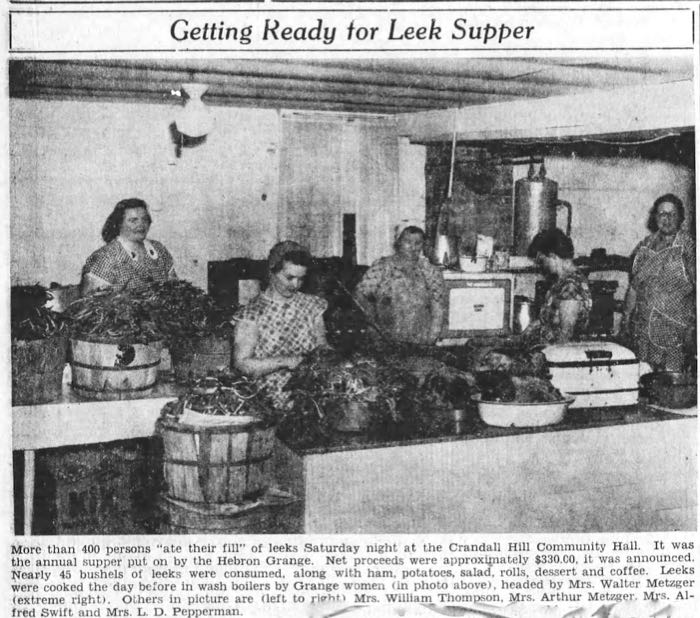
Our neighborhood Hebron Grange was reportedly the first in the Potter County area to offer leek suppers beginning in the 1930s. Cooked leeks served with plenty of ham and other homemade side dishes were the attraction.
From Potter Enterprise: 7 April 1949
Leek eaters, ATTENTION!
Want to attend that famous Hebron Grange Leek Supper on Crandall Hill this year?
You'll have to get up on your toes if you do.
Last year the leek-hungry public almost mobbed the good ladies of the Grange who were cooing the fragrant(?) leeks in 20-bushel lots.
This year different arrangements are being made. You leek eaters have gotta get your tickets in advance or you don't eat leeks. Only 300 will be sold.
Folks in Allegany County, McKean County and Cameron County better write to Mrs. Wanda Metzger, R.D. 2, Coudersport, if they want to fill up on the stinking liliaceous vegetable that springs up in the wild lands of Potter County in the springtime.
The dinner is scheduled for Saturday, April 23 at 6:00 p.m.
Reservations must be in not later than April 28.
Costs a buck and a half for adults and half that amount for the kids.
Get tickets in advance or you don't eat. Guess that's tellin' 'em off.
From 22 April 1954, The Potter Enterprise
Leek suppers!
The season is here. Hebron Grange, originator of leek suppers, will hold its 20th such annual event Saturday May 1.
The Grangers have dug, cleaned, cooked hundreds of bushels of the popular odoriferous spring greens.
When other organizations observed the public taste for leeks, they joined the leek supper parade and now a half dozen such events take place each year.
ADDENDUM:
from The Potter Enterprise, April 12, 1961:
Leek suppers –
Strange how Hebron Grange started a trend when it was a pioneer in serving leeks a number of years ago.
The idea caught on and the affair became so big that hundreds came to Crandall Hill to feast on the spring green, with plenty of other food.
The time came when each Grange family was assigned the task of hunting and digging a bushel of leeks. That was not all – he leeks had to be cleaned and washed. It was not a small task.
Now the picture has changed – Hebron Grange has resigned from the leek supper business. it is willing that others should carry on. The Grangers are too busy with other duties to dig leeks, wash them, cook and serve them.
Makes us a little sad to announce - No Hebron Grange leek supper this year.
![]() |
There's a long tradition of making sugar from maples in this neighborhood.
![]() |
| Potter Enterprise, April 4, 1907 |
We're not in the maple business but just over the hill, we enjoyed pancakes, sausage and maple syrup last weekend at Green Hill Sugar Shack.
![]() |
| 1916 |
![]() |
| 1930 |
Our neighbor, Kristin Gavin, showed up on our doorstep yesterday bearing this from their Applewood Hollow Farm. The Gavins live on the farm formerly owned by C.L. Stearns referenced above.
![]() |
| Destined for sourdough buckwheat cakes coming soon! |
![]() |
| From 1923 |
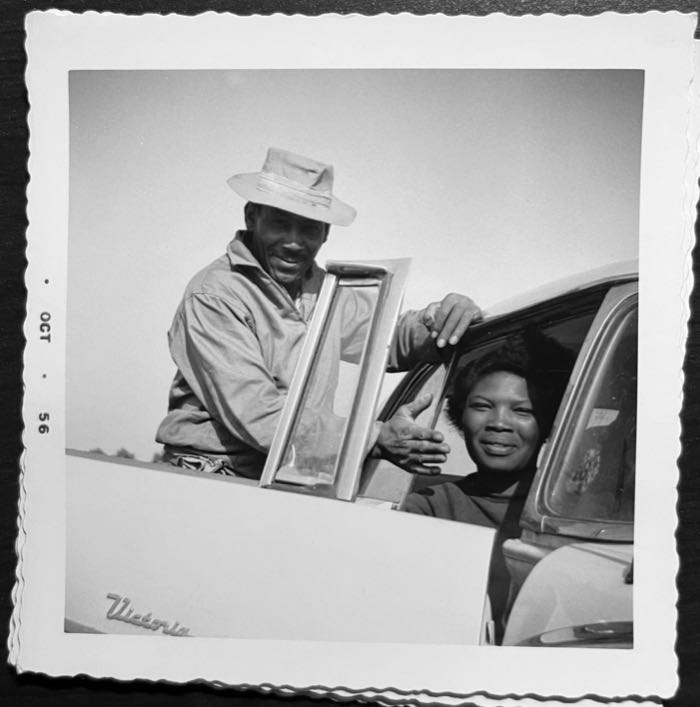
Old black and white photographs taken on the farm by Wanda Gooch Metzger in the 1950s provide a glimpse of life in the days when migrants traveled from the south to harvest vegetables in the summer.
It's not my story to tell but the photos stored in the White Owl cigar boxes are waiting for the words.
![]() |
| William and Esther Gardner |
In curating old photo files that belong to my mother, I came across this picture
and recognized at once that it was meant to accompany
the long-ago newspaper story I referenced below. Serendipity!
The winter months sometimes allow a little extra time for me to work on a project that has been in the works for many years. - compiling reminiscences written by my grandfather, W.D. Fish, known as "Golly" to those who looked for his column in the weekly newspaper.
Born in 1875, he lived in Allegany County near Whitesville during his youth and that's where he was bitten by the printing/newspapering bug. He worked for many area newspapers and print shops. He wrote a book (which was never published) about his time in Cross Fork in the early 1900s. But in the 1920s, he made Coudersport his home and The Potter Enterprise his newspaper.
Golly continued working at the newspaper until shortly before his death in 1969 and in the later years especially, he penned pages and pages of stories, written in pencil on now-yellowed newsprint. My mother squirelled them away and now they've made their way to me. And such treasures!
This particular piece was in a folder marked "filler" and here's the introduction page as I found it. It was likely written in the late 1960s.
It seems to fit well with my stories of this old farm. Though Arthur tells me he has not come across a grain flail, we do have a grain cradle from the old days.
This Crude Instrument Start Of Modern Harvest Methods
It is a simple invention that did service for the farmers of one hundred years ago. Today there are few people who could give its name or have any idea of its use.
It is a flail. It was used in the early days to thresh grain such as wheat, oats, barley, millet, buckwheat and other grains. It was a slow but effective way of separation of the grain from the straw.
The handle was perhaps four feet in length. The shorter piece of wood fastened to the handle with a loose toggle, probably of buckskin, was called a whipple or swingle.
The grain was scattered over the barn floor some six inches in depth. The operator moved the handle enough to let the swingle strike the straw to release the grains. The straw was removed and the grain, heavier than the straw, remained on the floor.
There was chaff and broken pieces of straw mixed with the grain. To remove the chaff it was tossed in the air when there was wind and the light refuse was blown away while the grain, being heavier, fell back to the floor. At a later date the fanning mill was invented to clean the grain.
The next improvement in threshing was steam power which hauled the machines know as "separators" and provided the power to thresh at the various farms of the neighborhood.
"Having threshers" was a day of activity on the farm, even until recent years.
A goodly crew was necessary to operate an operation successfully. Sometimes the farmers hired extra help and the thrashers, as they were called, had have a meal or two. It was up to the housewife and often a wife or two on nearby farms came to the rescue. The men worked hard and they were hearty eaters.
As a side light of those earlier days, the writer remembers hearing the comments of a man who worked one season on a traveling crew. Since fresh meat to feed the thrashers was often not to be had, the farm wife could always prepare a sufficient number of hens to provide food. For those traveling with threshing outfit, chicken became too much of a good thing. In those old days, one thresher declared that when asked a question he either cackled or crowed in response.
Today as one sees pictures of modern combines in the west, traveling northward driving the harvest of thousands of acres as the grain matures, he should hesitate a moment to think it all started with that simple little implement, the flail.
-- written by W.D. Fish
I never realized there is a day set aside on the calendar each year to celebrate apple cider. But there is and it's November 18.
From The National Holiday website: "Apple Cider Day is celebrated on November 18 every year. The day celebrates the rich and fruity beverage that fills our hearts and bodies with warmth. They say an apple a day keeps the doctor away, but a glass of apple cider at the end of a long day can rejuvenate the soul. Apple cider is made from freshly harvested apples that are mashed and made to resemble applesauce. This is then pressed to extract fresh juice."
Buy Cider From A Local Farm
Support local farmers. Ditch the 'cool' brands and buy your cider from a local farmer